Kata Transmission
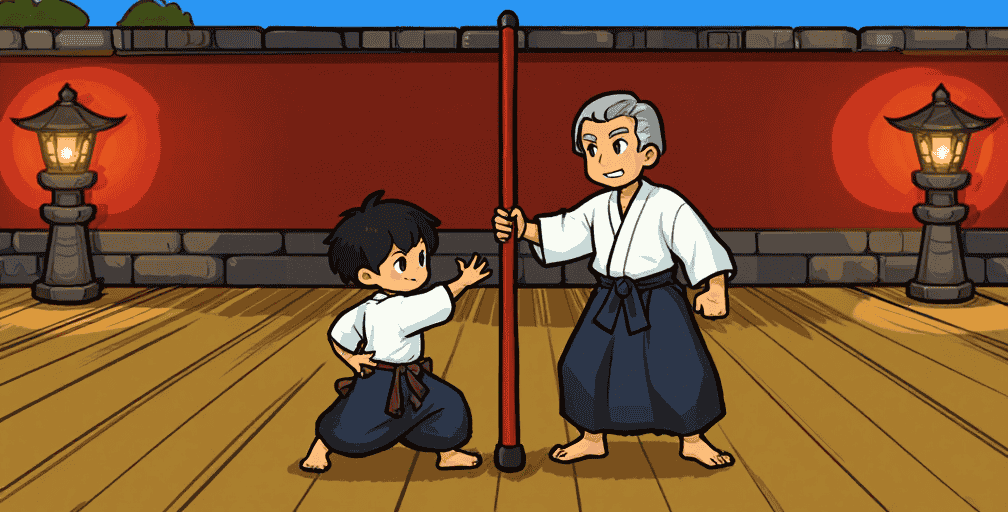
Unlike Japanese koryū weapon schools, which typically maintain formal licensing systems (menkyo) and written curricula (densho), Ryukyu kobudo was transmitted primarily through direct physical instruction without extensive written documentation. This has profound consequences for how we understand the relationship between different versions of "the same" kata.
Oral and Physical Transmission
A teacher would demonstrate a sequence repeatedly; the student would practice until the form was embodied. No written record accompanied this. The result is that the same foundational sequence could diverge significantly over two or three generations of transmission. Each generation would keep the core structure but adjust the footwork, timing, or technique to fit their own body and understanding.
When Taira Shinken collected kata in the early 20th century, he was working with living practitioners whose versions already differed. His curriculum is therefore not a single authentic transmission but a synthesis of multiple living branches, and a highly valuable one at that.
Place Names as Historical Markers
The place names in kata titles are the strongest evidence for historical origin:
- 北谷 (Chatan): a village north of Naha, associated with Chatan Yara
- 津堅 (Tsuken): a small island east of Okinawa, associated with boat-fighting and oar techniques
- 浜比嘉 (Hamahiga): an island in Katsuren Bay, associated with sai kata lineages
- 浦添 (Urasoe): a castle town north of Naha
When the same place-name kata appears across multiple organizations, it strongly implies a shared origin, even if the current choreography has diverged.
Post-War Divergence
The disruption of World War II (the Battle of Okinawa, 1945) severely interrupted transmission across all Okinawan martial arts. Many practitioners were killed or displaced. Post-war reconstruction of curricula involved some degree of reconstruction from memory and from parallel lineages. This is one reason why "sho/dai/ni" variants of the same kata appear across post-war schools. A single older form was divided into multiple versions at different training levels.
Documented Divergence: Sakugawa no Kon
The Sakugawa no Kon family offers the clearest documented example of transmission divergence. The kata bears the name of Sakugawa Kanga (佐久川 寛賀, c. 1762–1843), a Shuri practitioner who reportedly studied in China. Today, versions of Sakugawa no Kon exist in:
- The Taira line (three variants: Shō, Chū, Dai)
- Matayoshi Kobudo (one version)
- Yamane-ryū (distinct choreography emphasizing the style's fluid dynamic)
- Multiple karate-integrated weapon curricula (Shōrin-ryū, Shotokan derivatives)
All claim descent from the same historical practitioner. The choreographic variations across these modern versions represent at minimum three to four generations of separate transmission since the Meiji era. None can be called the "original" without access to documentation that does not exist.
This pattern of shared names, shared historical roots, and diverging modern choreography is the rule in Okinawan kobudo, not the exception.
Sources
- Okinawan kobudō — Wikipedia: Overview of transmission lineages and systematization by Taira Shinken
- Taira Shinken — Wikipedia: Documents his collection work from multiple teachers across Okinawa
- Yamanni ryu — Wikipedia: Documents Yamane-ryū versions of shared kata names (Sakugawa, Choun, Shuji)
- Research page: Key source texts on transmission history