Bō (棒)
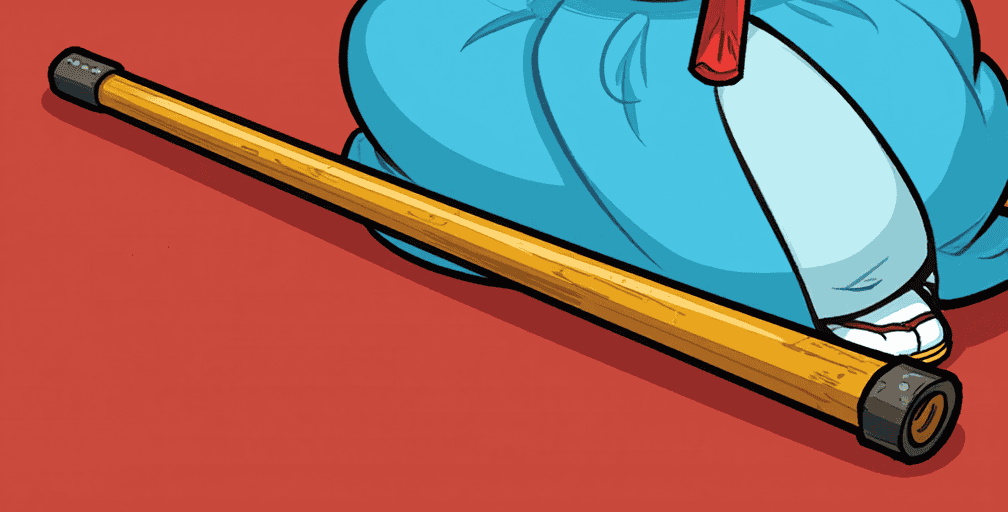
The bō (棒) is a hardwood staff approximately 6 feet (182 cm) long, known as the rokushakubō, and the most central weapon in Ryukyu kobudo. It carries the largest number of kata of any weapon in the corpus, and its kata names are the most widely shared across different styles and organizations.
Physical Characteristics
| Property | Detail |
|---|---|
| Length | ~182 cm (6 shaku) |
| Diameter | ~2.7 cm at center, tapered toward ends |
| Material | Red oak (akagashi) or white oak (shirogashi) |
| Weight | ~600–900 g depending on wood and taper |
Role in Kobudo
The bō was carried as a walking staff, a carrying pole, and a practical travel tool. Any length of hardwood can serve as a bō, which made it the natural foundation for a systematic weapon curriculum. Virtually every Okinawan kobudo organization begins serious weapon training with the bō.
Historical Origins
According to the article "琉球古武道武器術" by 揆奮館流武術, bōjutsu was originally the weapon of government officials (role similar to modern police) in the Ryukyu Kingdom, used for controlling disturbances rather than battlefield mass combat.
The same essay notes that Chinese military treatises such as 『武備志』 and 『紀効新書』 contain staff methods whose technical content closely resembles modern Okinawan bōjutsu, and quotes "all martial arts take staff (棍) as their root," emphasizing that staff work is the foundation of weapons practice.
Distinctive Characteristics
The article distinguishes Chinese staff (slender, whippy, skin‑cutting) from Okinawan staff (shorter, thicker, bone‑breaking) and describes traditional Ryukyu staff wood as kuba (クバ, a tough wood with wavy grain), before modern red/white oak became common. It notes that kingdom‑era guard bō were often five shaku, not the modern standard of six shaku.
Kata Families
The bō kata are organized by family. See Bō Kata for the full cross-style comparison. The most important families in the Taira-line curriculum:
| Kata family | Typical name | Notes |
|---|---|---|
| 周氏の棍 | Shūshi no Kon (Shō/Dai/Koshiki) | Core Shuri-region kata |
| 佐久川の棍 | Sakugawa no Kon (Shō/Chū/Dai) | Most cross-style of all bō kata |
| 添石の棍 | Soeishi no Kon (Shō/Dai) | Naha/Tomari area origin |
| 北谷屋良の棍 | Chatan Yara no Kon | Shared with empty-hand Chatan Yara tradition |
| 津堅棒 | Tsuken Bō | Tsuken island, boat-fighting roots |
| 白樽の棍 | Shirataru no Kon (Shō/Dai) | Shōrin-ryū weapon programs |
| 趙雲の棍 | Chōun no Kon | Chinese-flavored bō kata |
| 浦添の棍 | Urasoe no Kon | Urasoe regional lineage |
Paired Practice
Beyond solo kata, bō practice includes kumibō (組棒), which are pre-arranged partner sparring forms. These build timing, distance control, and the tactical application of the solo sequences. Technique is gripped in thirds, with one palm facing the opposite direction of the other, enabling the staff to rotate and block. Power is generated by the back hand pulling the staff; the front hand guides direction.
Sources
- Bō — Wikipedia: Physical characteristics (1.82 m / 6 shaku, 3 cm thick, red/white oak), grip technique, history of kobudo development in early 17th-century Okinawa
- Okinawan kobudō — Wikipedia: Bō as the most widely practiced weapon in the Ryukyu kobudo corpus
- Yamanni ryu — Wikipedia: Notes Yamane-ryū strikes resemble yari (spear) and naginata techniques
- 琉球古武道武器術 — 揆奮館流武術: Bō as government official weapon, Chinese military treatise connections (武備志, 紀効新書), staff as foundation principle, kuba wood, five vs six shaku distinction
- Okinawa Times — 琉球古武道の棒術: Traditional kuba wood, kingdom-era guard bō specifications
- 琉球古武術 — Japanese Wikipedia: Six-shaku staff dimensions, origin as carrying pole, kata naming conventions